Showing posts with label Centennial. Show all posts

Mar 30, 2014

Brewday: Playoffs Rye IPA take 4

First hop addition, 60 of 340g
A disproportionate number of my brews are American IPAs and Pale Ales - 22 out of my last 67 brews. I love a wide range of styles but it's harder to get a good, fresh IPA than most other things so I need to brew these more often to get my fix. One thing I don't think many people, even plenty of beer geeks, grasp properly is just how quickly beer deteriorates, hoppy beer in particular. Freshness is hugely important for most styles of beer. For a bit of an insight into what I mean, Literature and Libation has a great writeup of the experience of tasting the same IPA at 5 days and 90 days old.

The huge distance that most beer has to travel is something we have working against us in Australia. Our population is so spread out that beers have to travel a long way before they get to the majority of consumers. I've had way too many IPAs and pale ales with little to no discernible hop aroma. A bottle might be a month within its best before date but still be long past its actual best. In my dream world everyone has at least one brewpub within walking distance of their house and the beer is always fresh.

In this respect home brewers have a serious advantage over other craft beer consumers. No one gets to drink beer that's more fresh. For brewers who can brew to a decent standard, that means that the beer in their own homes is often better than the majority of commercially available beer. Avoiding the travelling distance and having control over storage makes a particularly big difference for IPAs and other modern hoppy beers. You're also always aware of how old the beer itself is and how soon it needs to be consumed.

All that is really just to say I'm excited about brewing my Playoffs IPA again and having some fresh IPA action. It should be ready just in time for this year's NBA playoffs which are looking like they'll be fun, especially in the West. This is my 4th crack at this particular beer. The first one I loved, the second I had a couple of enforced changes and was disappointed, the third was in late 2013 and was just ok. It suffered due to my rushed production and the aroma was not impressive. It was there but the current batch of Columbus is more potent than what I was using back in 2012 so it dominated in a way that wasn't what I was after and the overall aroma and flavour was a bit muddled and didn't 'pop' like it should have. This time I decided to make some changes to my process and the recipe to hopefully improve things.

Probably the biggest change is with the hops because I felt like going with something different this time. I may return to the original hop varieties eventually but this time I wanted to make use of the opportunity to try new combinations. I've switched out the Amarillo and Columbus of the original recipe and added in Centennial and Ahtanum. The ratios are a bit different as well, I've gone for 2:1:1 Centennial:Citra:Ahtanum throughout and added an extra dose of hops for a 50 minute sub-80C steep. The aroma as I transferred the wort into the fermenter fully justified the decision - it was incredible.

One of the pieces of feedback I received last time around was that the rye that was advertised didn't really come through so I've increased it to 20% of the grist compared to the original 14%. I also went with the Joe White Traditional Ale malt that I used originally instead of the pilsner malt of my last attempt. It was partly a decision to increase the colour and partly to avoid burning through my pilsner malt before I can get a re-up through a bulk buy.

The process changes are relatively small but will hopefully improve the finished product a little. I've been reading a bit about mash and post fermentation pH and it seems that a lower pH will help the hops to come across with more clarity. With that in mind I've aimed for a mash pH of 5.3 rather than the normal 5.45 I've usually been after. All this is theoretical though since I'm working with estimates off a spreadsheet rather than actual pH readings. All I can say for sure is that the pH is lower this time than when I've brewed it before. I'm considering buying a pH meter so I've got a better idea of what's going on with my mash and post fermentation pH levels.

I've also decided to start experimenting a bit with chloride:sulphate ratios. My normal practice with hoppy beers is to add a decent amount calcium sulphate and a small amount of calcium chloride. This time I'm keeping the sulphate addition in my normal range but I'm pushing the chloride a bit higher to see how it alters my perception of the beer. It's just something I haven't really experimented with at all up to this point and I've been wondering about it so I thought I'd make the change.

So with all that decision making out of the way, the brew itself should have been pretty straight forward but I ran into a couple of problems. The big one was that when I emptied my urn I found that part of the element had blackened. I've had that happen once before and that beer had rye in it as well so I'm guessing that's something to watch out for when using that grain. Fortunately the wort itself smelled and tasted great so I'm hoping that I got away with nothing more than a fair bit of scrubbing to remove the cooked on stuff. The other problem was small but annoying. I missed my gravity target even though I already aimed lower than normal in my recipe design (75% instead of my normal 80%). 1.061 instead of 1.062 isn't a big deal but poor efficiency was the reason I stopped using Joe White malt in the past and this result isn't a strong motivator for me to buy more. I think I need to alter the extract potential in my brewing software to compensate for that because it's obviously yielding less than its specs say. Those problems aside, the aroma of the wort was fantastic and if the finished beer has a similar character I'll be very happy.


Sad burnt on element
Playoffs Rye IPA #4 (20L batch)
OG: 1.062 (1.061 measured)
FG: 1.012
IBU: 66
EBC: 15.5
ABV: 6.7%

Recipe
76% Pilsner malt
20% Rye malt
4% Caramunich II

2.5g/l Aramis @ 60 min (41 IBU)
2g/l Centennial @ 0 minutes (for a 20 minute steep) (13 IBU)
1g/l Citra @ 0 minutes (for a 20 minute steep) (8 IBU)
1g/l Ahtanum @ 0 minutes (for a 20 minute steep) (3 IBU)
2g/l Centennial @ < 80C for a 50 minute steep
1g/l Citra @ < 80C for a 50 minute steep
1g/l Ahtanum < 80C for a 50 minute steep
3g/l Centennial @ dry hop
1.5g/l Citra @ dry hop
1.5g/l Ahtanum @ dry hop

WLP090


Method
Mash:
  • Added 10g CaSO4, 5g CaCl2, 2g MgSO4 to increase calcium and sulphate levels
  • 4ml lactic acid for pH correction
  • Stepped mash: 62C (45 minutes), 72C (15 minutes) and a 78C mash out

Boil:
  • 90 minute boil
  • 60g Aramis @ 60 minutes
  • 1/2 tab of whirlfloc @ 10 minutes
  • 40g Centennial @ 0 minutes
  • 20g Citra @ 0 minutes
  • 20g Ahtanum @ 0 minutes
  • 20 minute hop stand after flame out
  • Chilled to < 80C, added 20g each of Citra and Ahtanum and 40g Centennial for a 50 minute steep

Fermentation:
  • Oxygenated for 90 seconds
  • Began fermentation at 18C, I plan to increase it to 20C by the end of fermentation
  • I'll cold crash and add dry hops once fermentation is complete


Mar 22, 2014

Tasting: Hansard's Delight Red IPA

Hansard's Delight was brewed with and for my mate Luke on January 4. It was inspired by Little Creatures' limited run brew called Shepherd's Delight.


The label I made for Luke's embarrassment


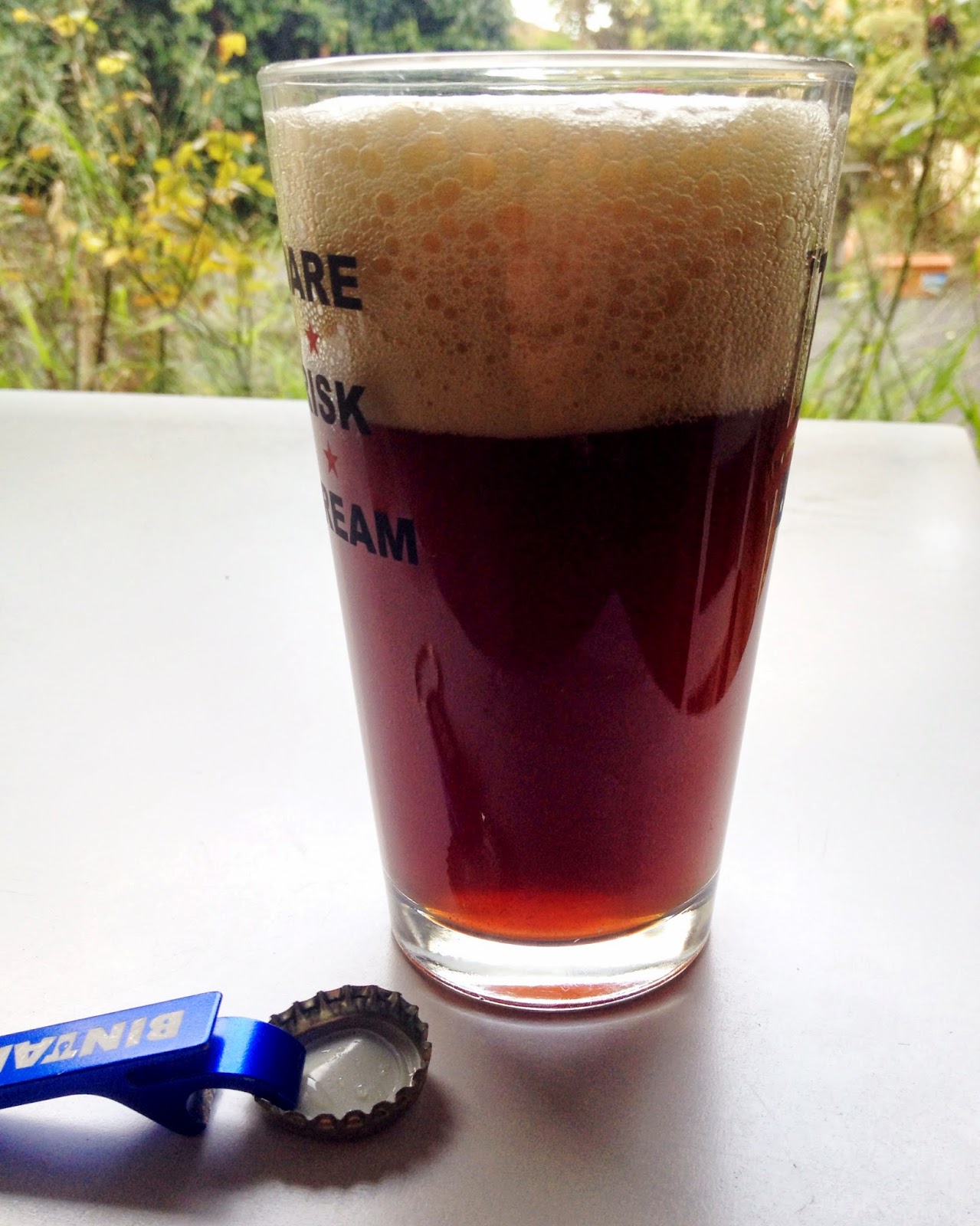
Aroma: Pine, sweet fruit, juicy, flowers. Bready malt. Some toffee and roast that complements the hops.
Appearance: Fairly dark but clear, deep red heading towards black. Red highlights. Thick, sticky and slightly off white head.
Flavour: Generous hop flavour, plenty of juicy berry flavours which mingle nicely with the malt. Some herbal flavours going on in there as well. Clean finish. Fairly restrained bitterness. A little bit much sweetness, possibly too much malt.
Mouthfeel: fuller mouthfeel than I'm looking for in an IPA, good low-medium carbonation level, no astringency.

Red like it says on the box

I don't know why it is but Red IPAs or their equivalents seem to be so hot right now in Australia, or at least so hot last year. Two of the best IPA style beers I had last year were Mountain Goat's Fancy Pants Amber Ale and Monster Mash's Hopped Out Red. They were probably the freshest commercial IPAs I've had and I'd love to get my hands on them again. Little Creatures' Shepherd's Delight was also a good showing in the genre although it wasn't quite up to the standards of the first two.

When I was planning the recipe I was uncertain about whether I'd get the red colour I was after and whether the hops would achieve what I wanted, a combination of light fruitiness with a bit of extra bite. Fortunately both those aspects of the beer ended up pretty much exactly as I intended which was a nice confidence boost. It's very approachable with a good, refined hop presence for a first pass at the recipe. As I've mentioned before, getting better at crafting recipes is one of my priorities for this year. It's pleasing to get one close to spot on with the first try. That said, I've got ideas for how to improve it.

If I was only going to make one change, I'd probably turn the malt down a bit. It's nice but there's a bit much malt flavour and at times it can feel a bit overwhelming. Blending the Golden Promise 50:50 with Australian pale malt or something like that. I think I'd also enjoy it a bit more if it was a little more dry, at the least it'd be more drinkable. If I was being really picky about it I think I'd also lighten the colour a little bit and perhaps fiddle with the ratio of Columbus and Centennial in the dry hopping stage. That sounds like a lot of changes but they're still keeping the beer fundamentally the same. The changes are all tweaks to wring the most out of what's already there rather than change too much about it.

Next time: Reduce the malt flavour a bit by shifting to a 50:50 Golden Promise:Australian pale malt blend, dry it out a bit more, slightly lower the Columbus and increase the Centennial in the dry hopping. I'd probably also make it a touch lighter in colour.


Feb 12, 2014

Brewday: Sideshow Brett - 100% Brett Baby IPA

The low gravity (aka Baby) IPA-style beer is a beer I keep coming back to. Big hop aroma, nice bitter kick but very drinkable. I know some people think it's stupid to call it an IPA when pale ale is the category for a pale hoppy beer that's lighter than an IPA. Still, I think that when the balance of bitterness is on the side of the IPA, the IPA label is appropriate and even helpful. If a label like IPA has any meaning, it's to give people an idea of what to expect before they drink it.

I've brewed several of these over the years with some good results and they're always somewhere on my torturously long list of 'what I'd like to brew next'. I've also been aiming to brew some kind of Brett IPA since August but between competitions, events and a couple of seasonal brews, I haven't been able to get to it until now. So here we are, two birds, one stone.

The yeast I used is fairly exotic. Last year my brother posted me a jar of Brett II from Saccharolicious, a home brew yeast supplier in Sweden. I've been itching to try it out in a beer but haven't gotten past making a starter. The starter gave me heaps of strawberry aroma and I'm hoping that those esters make it into the finished beer. I'm flying blind with regard to temperature and the esters it will give in primary fermentation so we'll just have to see how it goes.

The recipe is pretty much what I've used before for a 'clean' Baby IPA except for a smallish addition of flaked oats to ensure the beer has a decent body. Vienna and biscuit malt are there to maximise the malt flavour which is important in helping a low gravity beer punch above its weight. I've used it in the past with good results. With the hop combination I'm shooting for a big fruity and floral punch with plenty of bitterness to back it. Hopefully the Brett will give an extra dimension to the hops.

The good stuff! Crackerjack biscuit malt.

I'm still fairly new at 100% brett fermentations but these seem to be the key differences between a 100% brett beer and a 'clean' Saccharomyces fermentation:
  • Add some extra lactic acid/acidulated malt after the mash conversion is complete to get more fruity esters from the Brett. The lactic acid is converted during fermentation to ethyl lactate which can add creamy and fruit aromas.
  • A brett fermentation can leave a thin mouthfeel. It's a good idea to mash a bit higher than normal and maybe add flaked oats/barley/rye for body.
  • It's a good idea to grow up a bigger starter than with saccharomyces. I aimed for a pitching rate of 1.25 million cells/ml/degree plato or around 245 billion cells total. Most people seem to suggest something between standard ale and lager pitching rates.
  • Keep oxygen out! Brett tends to produce acid/funk when it's got access to oxygen, the aroma of my starter was crazy. We're talking about the stinkiest washed rind cheese smell ever, it was crazy. The original unstirred starter was all strawberry, hopefully that's what I get from the beer.
  • Fermentation temperature is a bit of an unknown for me with this yeast but it seems to be higher than I'd normally ferment an IPA. The yeast didn't come with any documentation so I'm making a guess based on WLP644 Brett Trois which says 21-29C. I started conservatively at 19C but it was sluggish until I increased it to 21C.


Hop stew: post boil hop stand
Sideshow Brett Baby IPA (22L batch)
OG: 1.035 (1.037 measured)
FG: 1.007
IBU: 35
EBC: 8.3
ABV: 3.9%

Recipe
88% Golden Promise
7% NFH Crackerjack (biscuit malt)
5% Flaked oats

5g Columbus @ 45 minutes
20g Simcoe @ 10 minutes
20g Galaxy @ 10 minutes
20g Centennial @ 10 minutes
30g Simcoe @ dry hop
30g Galaxy @ dry hop
30g Centennial @ dry hop

Brett II from Saccharolicious


Method
Mash:
  • 8g CaSO4, 2g CaCl2, 3g MgSO4 to increase the calcium and sulfate. 3ml lactic acid added during mash out to encourage the production of ethyl lactate.
  • Stepped mash: 66C (45 min), 72C (15 min) and a mash out at 78C.

Boil:
  • 60 minute boil with hop additions as above at 45 and 10 minutes.
  • Irish moss @ 15 minutes.

Fermentation:
  • Chilled but didn't oxygenate this time. 
  • Started fermentation at 20C, increased to 22C over 7 days.


31/01/14 - Brewed with help from Sacha

12/02/14 - Krausen has mostly dropped, I'll take a gravity reading in the next day or two and hopefully dry hop & bottle within the week.

22/02/14 - Finally got around to dry hopping

Jan 11, 2014

Brewday: Hansard's Delight Red IPA

My friend Luke enjoyed the Shepherd's Delight Red IPA, a Little Creatures Single Batch released sometime in 2013. He has a hunger for hoppy beers and asked me if I could brew a Red IPA. I said 'sure' and whipped up a recipe. That was at least 6 months ago and I never got around to brewing it. So I'm trying to mend my ways with my first brew for 2014.

The idea for this one is a deep red colour leaning towards black. People on the AHB forum recommend a combination of 5% CaraAroma and 1% Roast Barley to achieve a red colour so I went with that and made up the remaining 94% with Golden Promise and some munich malt. This was a chance to focus on presentation both in terms of colour and clarity so I hope it comes out with something that can be legitimately called red, not brown. The results during the brew looked promising.

For hops I went with a modest first wort hop addition and then added a heap of Galaxy and Centennial at the end of the boil for a hit of passionfruit, citrus and floral hops. Then there was another heavy dose of Centennial alongside Columbus for the dry hopping. I went for bitterness on the high end of the IPA scale (it's got an estimated 70 IBUs) to give it a decent bitter kick with the high level of malt flavour.

This was Luke's first experience of the brewing process from start to finish and it was fun to introduce him to the process behind the beer he drinks.

Hansard's Delight Red IPA (21L batch)
Luke very seriously adding the final hops
OG: 1.063 (1.061 measured)
FG: 1.011
IBU: 70 (estimated)
EBC: 34.2
ABV: 6.6%

79% Golden Promise malt
15% Best Malz Munich malt
5% Weyermann CaraAroma
1% Roast Barley

25g Columbus @ FWH min
60g Centennial @ 0 min
40g Galaxy @ 0 min
50g Centennial @ dry hop
50g Columbus @ dry hop

Starter of WLP 090, for an estimated pitch of 300 billion cells

8g CaSO4, 3g CaCl2, 3g MgSO4 went into the mash to get calcium up and raise the sulphate level to enhance the perception of the bitterness. I also added 2.5ml of lactic acid for pH correction.

Stepped mash: 64C (45 minutes), 72C (15 minutes) with a mash out at 78C

90 seconds of O2

04/01/14 - Brewed with Luke

Jan 5, 2014

Birthday Brew #1: Brewdog Hardcore IPA Clone

For the past 3 years my friend Jason's birthday has been an occasion to gather a bunch of beer loving friends and share some interesting commercial beers. He loves good beer and has been one of my most ardent home brew supporters. This year is his 30th and he's going all out with around 20 people coming to a 2 day event centred on camping out and slow cooking some delicious BBQ.


My part in it has been to brew 3 beers for the event. Jason and I were talking about the possibilities a couple of months ago and it was obvious that hops were going to be a big part of things. Jason wanted a version of a Nelson Sauvin single hop Pale Ale we brewed several times 3 years ago so that was easy. I'd just bought Mitch Steele's IPA book and saw the Brewdog Hardcore IPA recipe. The Hardcore IPA was one of the early Imperial IPAs was available to us and it made a big impression so that seemed like a good choice too. Finally, I'd been itching to brew my Playoffs IPA again so I took the opportunity to add that one to the list. Lots and lots of hops. Unlike the wedding, this birthday is mostly made up of people I know who are relatively educated in craft beer and Jason himself loves the hoppy beer so I didn't feel like I needed to moderate my choices like I did with the wedding.

Part of the challenge of brewing a big and hoppy beer with the BIAB method and using a 40L urn is in planning for and managing the losses. As the planned OG increases, the efficiency of converting and extracting the sugars decreases. I planned for 73% efficiency, down from the 80% which is my normal level, and ended up with 72% so I was pretty close. The good thing is that this information allows me to plan some other big beers with more confidence. Along with reduced efficiency, more hops means more wort losses at the end of the brew with the trub and hop debris left at the bottom of the urn. So factoring all of that in I was aiming for 15.5L of finished beer instead of the 19.5-21.5L I normally get.

In addition to the quantity challenges, I've also found quality a bit lacking in the higher ABV beers I've brewed. They've tended to be good but not great, often suffering from off flavours. I've managed to get off flavours through an inadequate pitch of yeast, high alcohol levels or insufficient O2 stressing the yeast and high fermentation temperatures. I've collected the whole set. So with this one I was trying to do everything I could to make sure the yeast was happy and the fermentation was clean. I oxygenated the wort for 2 minutes, twice what I do for a beer in the 1.050s and I built up a massive pitch of yeast (an estimated 330 billion cells). Everything went quite well and the only problem with it was that it didn't ferment all the way down to the 1.014 I was after. With hindsight, I think I should have picked up some yeast nutrient to give them a little extra love and perhaps mashed lower than the 65C I went with.

Brewdog Hardcore IPA Clone (17L batch)
OG: 1.083 (1.082 measured)
FG: 1.014 (1.020 measured)
IBU: 148
EBC: 21.8
ABV: 9% (8.3% measured)

90% Maris Otter
6.5% Caramalt
3.5% Simpsons light crystal

25g Columbus @ 75 minutes
25g Centennial @ 75 minutes
12g Columbus @ 60 minutes
12g Centennial @ 60 minutes
33g Columbus @ 0 minutes
33g Centennial @ 0 minutes
33g Simcoe @ 0 minutes
50g Columbus @ dry hop

Estimated pitch of 330 billion cells of WLP 090

120 seconds of oxygen

I added 200g acidulated malt to correct the mash pH and added 11g CaSO4, 2g CaCl2, 3g MgSO4 as the recipe said to burtonise the water. I wasn't keen to push the sulphate levels higher than I did although I may test the limits of that another time.

Stepped mash: 65C (45 minutes), 72C (15 minutes) and a 78C mash out.

14/12/13 - Brewed with Huw

24/12/13 - Added 50g Columbus dry hops

28/12/13 - Bottled

Tasting notes
Related Posts Plugin for WordPress, Blogger...